


Tyre
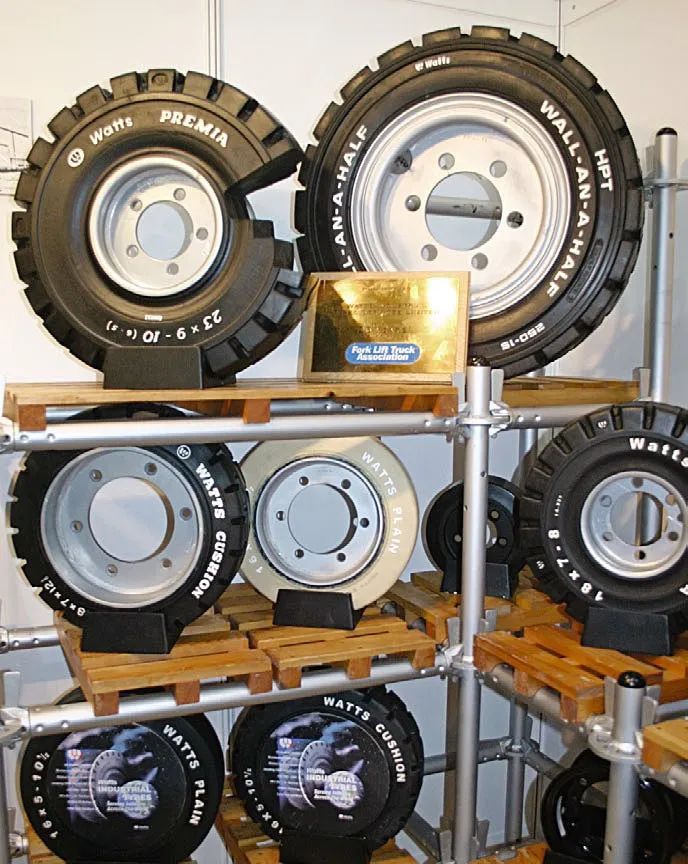
At first glance, it seems strange, but the mobility and speed of forklift depend largely on parts such as tires. Until the late 1930s, forklifts were usually equipped with solid tires. First, a ring of dense and wear-resistant rubber ring is pasted onto the rim. And then it’s pressed together with it on the cylindrical rim. In the first of these rough combinations, the rim usually slipped with the rubber ring. Today, that problem is completely solved. The shape of the rim and the edge of the tire should correspond exactly to each other. Later, to ensure that forklifts didn’t leave marks on the floor when braking, inflatable tires and hyperelastic tires were used.
In terms of the application of tires, the US market is quite different from other markets. Forklifts are mainly equipped with solid tires. In other parts of the world, forklifts mostly use pneumatic or solid tires. Solid tires provide the most reliable grip when working on flat surfaces or roads. Equipped with forklifts with inflatable or large tires, the structure is more compact with the same carrying capacity and stability. Unfortunately, the driver’s comfort level has been reduced. In 1936, Hyster introduced Jumbo 7T, the first heavy-lift truck with inflatable tires. Currently, forklifts equipped with pneumatic or solid tires can successfully complete their operations on rough ground, maximizing handling comfort.
Braking System
For braking systems, this’s mainly due to the development of hydraulic structures to improve comfort and safety. In the 1920s to 1930s, Clark released the first material transport trolley, and some other models of the equipment didn’t have brakes. Only the next generation of equipment used mechanical braking but it was soon replaced by hydraulic braking systems. At present, almost every forklift over 2 tons is equipped with brake booster, even the smallest pedal can make the braking process dynamic. To reduce the maintenance cost of these systems, most Korean companies equip forklifts with oil-pressure disc brakes – similar to ABS braking systems. Examples include Daewoo (now Doosan), Hyundai and Samsung. Other companies only use standard equipment for heavy duty forklifts. Until recently, the technology was too expensive. But experience has shown that many of the advantages of hydraulic disc brakes far outweigh their disadvantages, namely high cost. Reliability was significantly improved to a smoother braking process, especially with increased braking power without locking the wheels.
In other developments, braking technology has gone its own way with the introduction of hydrostatic drives by Germany’s LINDE. Through static force transfer, both acceleration and braking (side effects of hydrostatic drive) can be achieved. And only two pedals controlled forward and backward movement. The hydrostatic forklift is the most effective for acceleration and direction change of forklift. Caterpillar, Clark and Jungheinrich have all tried to grow in this area, but so far they have been unsuccessful.
-500x383.webp)


Thank you for your blog. Thanks Again. Much obliged. Sorcha Roscoe Hephzipa
This article is truly a good one it assists new net users, who
are wishing for blogging.
Thanks! Keep going!!
I do not even know how I ended up here, but I thought this
post was once great. I don’t realize who you’re but certainly you are going to
a famous blogger in the event you aren’t already. Cheers!
Hi there, everything is going well here and ofcourse every one is sharing data, that’s really fine, keep up writing.
My page … манивео и ты красава
Thanks for your read, the sequel (part 4) will be released soon!!
After exploring a few of the articles on your site, I honestly appreciate your technique of writing a blog.
I saved as a favorite it to my bookmark webpage list and will be checking back in the near future.
Please check out my website too and tell me your opinion.
What’s up, everything is going well here and ofcourse every
one is sharing facts, that’s really fine, keep up writing.
I used to be able to find good info from your articles.