

Oilgear PVWC Hydraulic Pump
Features and benefits of the Oilgear PVWC Pump
1.Large selection of controls.
- Several types of mechanical, hydraulic andelectrohydraulic servo valve controls are available.
- Allow cushioned “across-center” delivery reversal.
- Field interchangeability without disconnectingpump from main drive or system piping.
- Neutral “by-pass” types available.
2. Cylinder carried in polymerous journal bearing
- Provides longer bearing life
- Permits compact design.
- Allows operation with low viscosityor other special fluids.
- Hardened cylinder surface running onhardened valve plate.
3. Hardened cylinder surface running on hardened valve plate
- Greater resistance to contamination.
- Provides longer life.
- Allows operation with low viscosity or other special fluids.
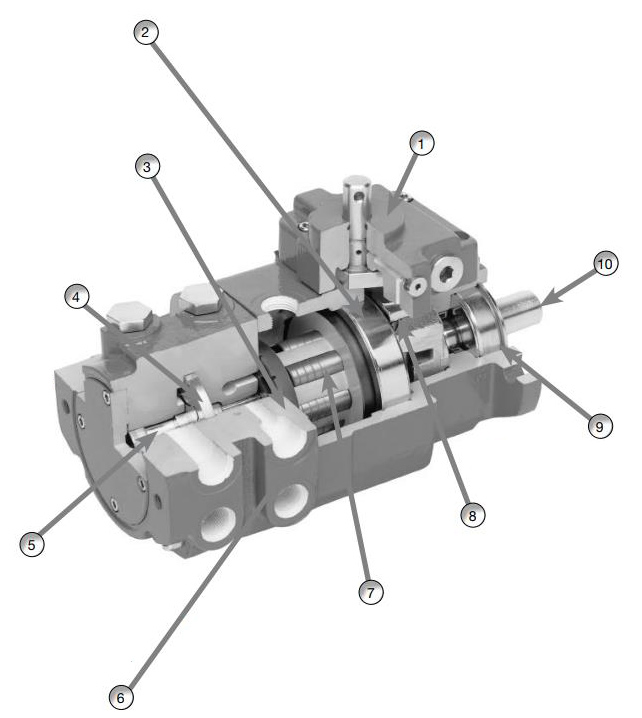
4. Built-in supercharge and/or implement pump available.
- Circuited to replenish piston pump in (closed loop) hydrostatic circuits. Provides for operation of implement or system accessories.
5. Thru-shaft and “plug-in” rear coupling availability (after removal of rear cover).
- Allows multiple pump installation from a single driveshaft
- Can be used to drive auxiliary devices.
6. Three capacities per single frame size.
- Allows selection of capacity (speed) and pressure (torque) to most closely match the need while providing maximum control range sensitivity (gain).
7. Pistons with steel shoes and special faces for increased fluid retention, running on a hardened swashblock surface.
- Provides a higher degree of contamination resistance.
- Allows higher pressure operation.
- Provides longer life.
- Allows operation with low viscosity or other special fluids.
8. Special polymerous bearing between swashblock and saddle.
- Permits consistent control reaction.
- Eliminates troublesome yoke bearings.
- Provides long life.
9. Sealed front shaft bearing.
- Allows side loading.
10. SAE splined or keyed shaft.
- For convenient coupling to your specific rotary power source.
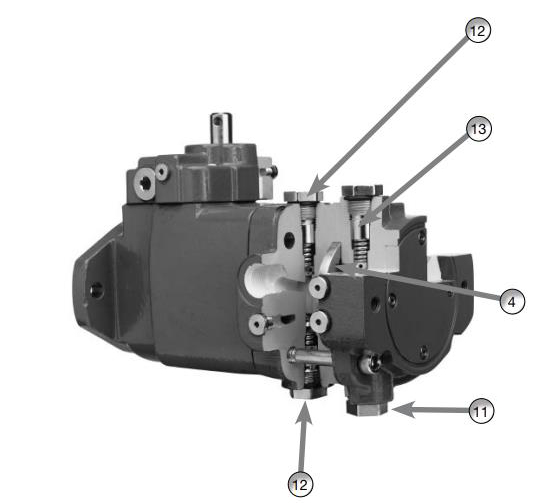
11. Built-in supercharge pressure relief valve.
- Maintains back pressure in the
supercharge circuit to replenish
piston pump. - Allows surplus return and/or
supercharge volume to escape system.
12. Two cross-line check valves with (optional) high pressure relief valves
- Automatically provide replenishing volume to low pressure side of circuit.
- Protect high pressure pump drive and machine from overload damage if system pressure is exceeded.
- Provide cushioned hydrodynamic or regenerative braking of driven hydraulic motor.
13. Built-in implement pressure relief valve available.
- Protects implement (or accessory)
circuit and supercharge pump from overload pressure and damage.
PLUS Not Shown in cross section photos
14. Totally enclosed.
- Impervious to high pressure wash down.
- Can be operated in hazardous locations, with totally enclosed drive motors.
15. Can be easily mounted in any position.
- Easy to install.
16. “Tow” valve option.
- Allows “free-wheeling” of hydraulic motor when being transported (towed).
| Maximum Piston Pump Displacement | PUMP MODEL | ||
PVWC 011
| PVWC 014
| PVWC 022
| |
Operating Pressure (see Note 1)
| –
| –
| –
|
Output Flow (see Note 2)
| –
| –
| –
|
Input Shaft Speed
| –
| –
| –
|
Charge Pressure (@ 1800 rpm)
| –
| –
| –
|
Case Pressure
| –
| –
| –
|
Hydraulic Fluid Temp (@ pump inlet)
| –
| –
| –
|
| Charge Pump Displacement (Optional) | .425 cipr (7 cc/rev) .64 cipr (10.5 cc/rev) | ||
Operating Pressure
| –
| ||
Note 1:
- Running Piston Pumps above pressures indicated will shorten the pump’s life.
- To avoid damage, supercharge flow must be continuously supplied to the piston pump
Note 2:
- Output flow based on ISO 46 hydraulic fluid at 125° F.
Pump Mount (all displacements) | SAE “A” 2-bolt SAE “B” 2-bolt |
Input Shaft Options (all displacements) |
|
Port Type (all displacements) | #8 SAE Straight Thread (all connections except inlet port of .64 cipr Charge Pump are #10 SAE Straight Thread) |
Direction of Rotation (all displacements) | Clockwise or Counterclockwise |
Installation Position (all displacements) | Horizontal or Vertical at any clocking |
Tandem Mount (all displacements) | SAE “A” 2-bolt with SAE “A” Spline drive |
High Pressure Relief Valve (Block number 16 of model code)
| MODEL CODE DESIGNATION | NOMINAL SETTING | CRACKING PRESSURE | |
| Minimum | Maximum | ||
| 10 | 1450 psi (100 bar) | 1378 psi (95 bar) | 1523 psi (105 bar) |
| 14 | 2030 psi (140 bar) | 1929 psi (133 bar) | 2132 psi (147 bar) |
| 17 | 2500 psi (175 bar) | 2410 psi (166 bar) | 2664 psi (184 bar) |
| 19 | 2730 psi (188 bar) | 2610 psi (180 bar) | 2842 psi (196 bar) |
| 21 | 3045 psi (210 bar) | 2893 psi (200 bar) | 3197 psi (220 bar) |
| 25 | 3625 psi (250 bar) | 3444 psi (238 bar) | 3806 psi (262 bar) |
| 28 | 4060 psi (280 bar) | 3857 psi (266 bar) | 4263 psi (294 bar) |
| 35 | 5075 psi (350 bar) | 4821 psi (332 bar) | 5329 psi (368 bar) |
Implement Pressure Relief Valve (Block number 17 of model code)
| MODEL CODE DESIGNATION | NOMINAL SETTING | CRACKING PRESSURE | |
| Minimum | Maximum | ||
J E or F K L | 725 psi (50 bar) 913 psi (63 bar) 1160 psi (80 bar) 1450 psi (100 bar) | 689 psi (48 bar) 867 psi (60 bar) 1102 psi (76 bar) 1378 psi (95 bar) | 761 psi (52 bar) 959 psi (66 bar) 1218 psi (84 bar) 1523 psi (105 bar) |
